
Salesforce Roles: Admin, Developer, or Architect?
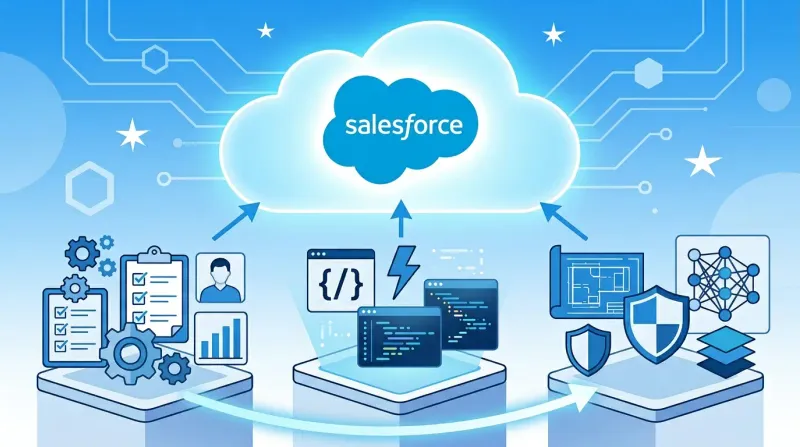
When I first stumbled into the Salesforce ecosystem as a Technical Test Analyst, I did not know the difference between an Admin, a Developer, or an Architect. I knew what an architect was in general, but not what a Salesforce Architect actually did, and I definitely did not know which path suited me.
The truth is, Salesforce careers offer diverse paths to match different interests and strengths. The best starting role depends entirely on how you prefer to solve problems, how technical you want your day-to-day work to be, and whether you want to focus on platform operations, product delivery, or architecture strategy.
This guide compares the three core platform paths: Administrators who keep the platform running through configuration and automation, Developers who build custom code and integrations when clicks aren’t enough, and Architects who design the overarching technical strategy for complex environments. My own path through the ecosystem has included testing, development, and architecture, and that hands-on progression is what I use to shape these comparisons. By the end of this guide, you’ll be able to choose your path based on real responsibilities, skill expectations, and growth opportunities rather than getting hung up on job titles alone.
👥 Who This Guide Is For
Section titled “👥 Who This Guide Is For”This guide is for you if you are:
- Just getting started in Salesforce and trying to figure out where to focus first.
- Moving over from another role, such as business analyst, support, QA, or full stack development.
- Hiring for Salesforce capability and not fully sure which role your team needs.
- Thinking about moving from hands-on delivery to a technical leadership path.
No prior Salesforce role experience is required to benefit from this page.
🎯 What This Page Helps You Decide
Section titled “🎯 What This Page Helps You Decide”After reading this page, you should be able to:
- Clearly understand where Admin, Developer, and Architect responsibilities begin and end.
- Match your strengths and interests to a realistic starting role.
- Spot when one person can cover multiple roles, and when specialisation is the better choice.
- Jump straight to deeper, role-specific guides and official learning resources.
📌 Salesforce Roles at a Glance
Section titled “📌 Salesforce Roles at a Glance”| Role | Focus | Typical Work | Primary Tools | Best Fit If You Enjoy |
|---|---|---|---|---|
| Administrator | Platform configuration and operations | User setup, security access, automation, reporting, data quality | Flow, Reports, Dashboards, Permission Sets, Object Manager | Improving processes, supporting users, and optimising operations |
| Developer | Custom build and integration delivery | Apex logic, Lightning Web Components, APIs, testing and deployment | Apex, Lightning Web Components, SOQL, APIs, DevOps tooling | Building features, solving complex logic, and coding solutions |
| Architect | End-to-end design and governance | Solution design, integration patterns, security model, scalability decisions | Architecture patterns, platform limits guidance, governance frameworks | Designing systems, balancing trade-offs, and technical leadership |
🏢 How Role Boundaries Change in Real Teams
Section titled “🏢 How Role Boundaries Change in Real Teams”Role definitions differ by organisation size and maturity, but the work still needs a clear owner:
| Decision or outcome | Usually leads | Bring in another role when |
|---|---|---|
| User access, reporting, data quality, and day-to-day platform health | Admin | The change introduces code, a wider security boundary, or shared architectural risk |
| Custom logic, integration implementation, code quality, and technical support | Developer | The choice affects platform-wide patterns, business ownership, or operational governance |
| Data, integration, security, environment, and delivery strategy across solutions | Architect | Implementation detail needs Admin or Developer ownership, or the business must accept a trade-off |
| Business process, priorities, acceptance criteria, and measurable outcomes | Product or business owner | Technical feasibility, platform constraints, or operational risk must be assessed |
In a small team, one person may wear several hats. That is workable if they make the hat change explicit: the person proposing a design should still seek an appropriate review for a high-risk decision. Scope and accountability matter more than labels.
🧪 How We Compare Roles on JamForce
Section titled “🧪 How We Compare Roles on JamForce”We built these role guides around the questions people usually ask when choosing a Salesforce path. For each role, we focus on practical criteria you can actually use to decide:
- What you are expected to own and deliver day to day
- Which tools and platform capabilities you will use most
- What skills are expected at different career stages
- How each role typically collaborates with other teams
- What progression can look like over time
Where possible, we link to official Salesforce learning and certification resources so you can validate what you read here and plan your next steps confidently. The goal is not to flatten these roles into neat job-title definitions, but to reflect how they usually work in real teams where ownership, risk, and collaboration matter more than labels.
🚀 Explore Each Role
Section titled “🚀 Explore Each Role”Each path has a dedicated guide. Pick a role below to see responsibilities, skills, and career progression.

Salesforce Developer
Build custom applications using Apex, Lightning Web Components, and integrations. Extend Salesforce beyond standard functionality.
Salesforce Architect
Design scalable, secure architectures and governance frameworks. Lead enterprise implementations and technical strategy.📖 Suggested Reading Path
Section titled “📖 Suggested Reading Path”If you are brand new to Salesforce careers:
- Start with Salesforce Administrator for platform fundamentals and business process understanding.
- Continue to Salesforce Developer to assess your interest in coding and technical delivery.
- Finish with Salesforce Architect to understand system level design and leadership expectations.
If you are already technical, read Developer and Architect first, then review Administrator to strengthen platform operations and governance context.
🧭 How to Choose Your Path
Section titled “🧭 How to Choose Your Path”
Job titles on LinkedIn rarely tell the full story. In my own journey, I initially thought having a “Developer” title meant I would just write code all day, but I quickly learned that these boundaries blur in the real world (and that knowing the Admin side makes you a vastly better Developer). Use the signals below to match how you actually like to work, then read the anti-signals honestly. Choosing the wrong starting path is common; catching it early saves months of frustration.
👤 Administrator
Section titled “👤 Administrator”Choose this path if:
- You prefer configuration and process design over writing code
- You enjoy user support, training, and keeping the platform tidy for others
- Your organisation needs operational excellence, access control, and reliable reporting
- You like turning messy business requirements into working Flows and object models
This path may not be for you if:
- You want most of your week in an IDE building custom UI and integration code
- You dislike repetitive tickets, access requests, and explaining the same setup to new users
- You find governor limits and integration patterns more interesting than business process design
- You need to own enterprise integration architecture as your primary deliverable (Developer or Architect tracks fit better)
Trailhead: Admin Career Path
💻 Developer
Section titled “💻 Developer”Choose this path if:
- You love coding and solving problems through Apex, Lightning Web Components, and APIs
- Your business needs custom logic, integrations, or UX that declarative tools cannot deliver cleanly
- You are comfortable reading platform limits, writing tests, and debugging production issues
You might struggle if:
- You dislike debugging or working with abstract logic for long stretches without visible UI progress
- You want quick wins only through clicks and setup screens, with little interest in code review or deployments
- You find stakeholder workshops and documentation a distraction from “just building it”
- You expect every problem to have one clean technical answer (Salesforce often needs pragmatic tradeoffs)
Trailhead: Developer Career Path
🏗️ Architect
Section titled “🏗️ Architect”Choose this path if:
- You think in systems: security models, integration boundaries, data ownership, and scalability
- You work on enterprise programmes or transformations where bad design is expensive to undo
- You enjoy governance, roadmaps, and helping teams align on standards
This path may not be for you if:
- You mainly want to be a “senior developer” with more coding and less facilitation (that is a valid career, but it is not the same as architecture)
- You dislike tradeoff conversations, written decision records, and stakeholder alignment when requirements conflict
- You want hands-on delivery every day and find architecture reviews or steering groups draining
- You are early in your Salesforce journey with little delivery experience yet (most architects grow from strong Admin or Developer foundations first)
Trailhead: Architect Career Path
📈 Career Progression in the Salesforce Ecosystem
Section titled “📈 Career Progression in the Salesforce Ecosystem”Salesforce careers rarely follow a straight line. Most people build skills in stages, move sideways, and grow into roles that match their strengths.
Some common paths include:
- Administrator → Business Analyst → Architect
- Developer → Integration Specialist → Architect
- Functional Consultant → Solution Lead → Solution Architect
- Administrator → Senior Admin → Platform Manager
✅ Trust and Source Notes
Section titled “✅ Trust and Source Notes”This comparison is educational and is reviewed against Salesforce official role and certification resources, Trailhead learning paths, and the practical delivery patterns covered throughout the linked role guides. Individual job titles, responsibilities, and salary bands vary by company, region, and industry, which is why this page focuses on actual ownership patterns rather than title alone.
✅ Conclusion
Section titled “✅ Conclusion”Choose the role by the outcomes you want to own, not by which title sounds most senior. Admins keep the platform useful and trustworthy, Developers take responsibility for custom engineering, and Architects own the system-level trade-offs that span teams and solutions.
Those boundaries will overlap, especially in smaller organisations. The important thing is to recognise which hat you are wearing, understand when a decision exceeds that role’s safe boundary, and involve the right people before a local solution becomes a production problem.
Start with the detailed role guide closest to the work you want to do, then read the adjacent role as well. Understanding the hand-off is one of the quickest ways to become more effective in your chosen path.
🛠️ Quick Start Resources
Section titled “🛠️ Quick Start Resources” Free Developer Org Create a free practice org for exploring administration and platform development.
Trailhead Learning Platform Interactive learning paths for Admins, Developers, and Architects with hands-on challenges.
Salesforce Certification Review current Salesforce credentials, exam guidance, and certification paths.