Salesforce Industry Clouds: Health, Finance & Manufacturing
Generic CRM implementations often fall short when they ignore industry realities such as compliance, domain-specific data models, and complex operating workflows. Salesforce Industry Clouds address this by providing purpose-built capabilities for sectors like financial services, healthcare, manufacturing, and the public sector. In this guide, you’ll get a practical overview of key Industry Clouds, where they fit, and how to start learning them.
If you are also mapping your broader Salesforce landscape, compare this with Sales Cloud, Service Cloud, and Marketing Cloud Engagement. For Salesforce’s official cross-industry positioning, see the Salesforce Industries solutions overview.
🧠 What are Salesforce Industry Clouds?
Section titled “🧠 What are Salesforce Industry Clouds?”Salesforce Industry Clouds are cloud-based solutions tailored to address the specific needs of industries including healthcare, financial services, retail, and manufacturing. Built on the Salesforce platform, these solutions offer industry-specific data models, workflows, and capabilities that support digital transformation, reduce the need for extensive customisation, and help organisations implement their own governance and compliance requirements.
These Industry Clouds extend beyond general-purpose CRM by offering prebuilt functionality aligned with common industry processes, minimising the need to design every data model and workflow from scratch. This can accelerate delivery and give compliance teams a stronger starting point, but it does not make the finished implementation compliant by itself.
The useful question is not “does Salesforce have a cloud for our industry?” It is “how much of its packaged model and process can we adopt without fighting the way the organisation actually works?”
| Situation | Prefer an Industry Cloud | Prefer core platform first |
|---|---|---|
| Data model | Packaged entities closely match the domain | Most packaged entities would be ignored or worked around |
| Process | Prebuilt workflows remove genuine design effort | Differentiating processes would still be heavily customised |
| Skills | Team can support OmniStudio and the product-specific model | Team needs a simpler admin/Flow operating model |
| Commercial case | Licence and implementation cost is offset by reusable capability | Only a small subset of the package creates value |
| Compliance | Controls provide a useful implementation foundation | Stakeholders expect the product name itself to guarantee compliance |
Availability is product-specific. An Industry Cloud can require a particular Salesforce edition, separate licences, add-ons or a provisioned trial, and the packaging can change. Validate the exact SKU and environment access with Salesforce before treating a feature shown in a product overview as part of your entitlement.
🗂️ Exploring Salesforce Industry Clouds
Section titled “🗂️ Exploring Salesforce Industry Clouds”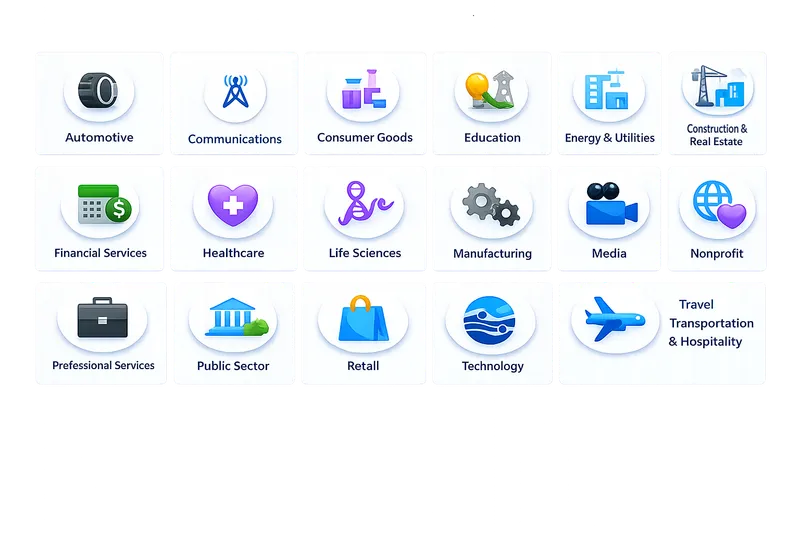
Salesforce Industry Clouds are specialised solutions designed to meet the unique needs of various industries. Built on the Salesforce platform, these clouds leverage capabilities like AI, workflows, and Customer 360 integration to deliver industry-specific solutions that enhance operational efficiency and customer experiences. Below is an overview of key Industry Clouds and their features:
💳 Financial Services Cloud
Section titled “💳 Financial Services Cloud”Designed for financial institutions, Financial Services Cloud supports wealth management, banking, and insurance client relationships. Key features include 360-degree client views, compliance management, tailored client engagement tools, and financial account tracking to enhance productivity and personalised advice delivery.
🏥 Health Cloud
Section titled “🏥 Health Cloud”Tailored for healthcare and life sciences, Health Cloud supports patient management and care coordination. It focuses on patient profiles, care plans, health data integration, privacy and consent controls that can support a HIPAA-aligned implementation, and collaboration tools for care teams. The customer still owns the configuration, access model, operating controls, and legal assessment needed for compliance.
🏭 Manufacturing Cloud
Section titled “🏭 Manufacturing Cloud”Manufacturing Cloud provides insights to manage production and supply chains efficiently. It offers sales agreement management, demand forecasting, account-based forecasting, and operations visibility to align sales and production processes.
🛒 Consumer Goods Cloud
Section titled “🛒 Consumer Goods Cloud”Consumer Goods Cloud helps consumer goods companies optimise retail execution, improve field sales operations, and optimise customer engagement. Features include retail visit planning, shelf and inventory management, campaign execution, and customer engagement insights.
📡 Communications Cloud
Section titled “📡 Communications Cloud”Designed for telecommunications and media companies, Communications Cloud supports customer lifecycle management, service assurance, order management, and network operations, enabling improved customer experiences and operational efficiency.
⚡ Energy and Utilities Cloud
Section titled “⚡ Energy and Utilities Cloud”Energy and Utilities Cloud supports energy and utility companies with asset management, field service, outage management, and customer engagement tools tailored to utility-specific workflows and regulatory needs.
🏛️ Public Sector Cloud
Section titled “🏛️ Public Sector Cloud”Aimed at government agencies and public sector organisations, Public Sector Cloud assists with case management, constituent services, grant management, and licencing, promoting transparency and efficient citizen engagement.
🎓 Education Cloud
Section titled “🎓 Education Cloud”Tailored for educational institutions, Education Cloud focuses on student lifecycle management, recruitment, retention, alumni relations, and fundraising capabilities to streamline institutional operations.
🌐 Other Industry Clouds
Section titled “🌐 Other Industry Clouds”Salesforce also offers Industry Clouds for sectors such as automotive, media and nonprofit, each providing specialised features that address unique workflows and regulatory requirements for those industries.
These Industry Clouds are designed to address the distinct challenges and workflows of their respective industries, enabling organisations to modernise, innovate, and deliver superior customer experiences.
🔧 Key Features of Salesforce Industry Clouds
Section titled “🔧 Key Features of Salesforce Industry Clouds”Industry Clouds are not identical bundles with different labels. Each product packages capabilities around its own sector, but several patterns appear across the portfolio. These are the features worth looking for when you assess whether an Industry Cloud gives you a meaningful head start over the core platform.
- Industry-specific data models extend the standard Salesforce object model with entities and relationships for a particular domain. This can remove months of modelling work, but a prescriptive model becomes expensive when the organisation refuses its terminology or structure.
- Prebuilt workflows and components provide starting points for common onboarding, service, sales, care, application, or case-management processes. They still need fit-gap analysis, testing, ownership, and adaptation to the organisation’s operating model.
- OmniStudio capabilities such as Omniscripts, Flexcards, Data Mappers, and Integration Procedures support guided journeys and multi-source data interactions. Many Industries products include OmniStudio, but availability and runtime vary, and the specialist development and deployment skills must be included in the delivery plan.
- Rules, data processing, analytics, and AI can provide reusable foundations for domain calculations, decisions, measures, and assisted work. The exact tools depend on the product and entitlement, while data quality, explainability, monitoring, and human review remain customer responsibilities.
- Security, privacy, and consent controls can support the implementation of regulated data and processes. They provide a foundation rather than a compliance guarantee; configuration, access, evidence, procedures, and legal interpretation remain with the customer under the shared-responsibility model.
- Packaged integrations and APIs can shorten common connection patterns and, in some products, provide configurable MuleSoft assets. Prebuilt integration does not remove data mapping, error handling, ownership, monitoring, or version management.
The business case should count only the packaged capability the organisation will genuinely adopt. A large catalogue is not value if most of it is disabled, duplicated by another platform, or replaced with custom objects and flows.
🚀 Getting Started with Salesforce Industry Clouds
Section titled “🚀 Getting Started with Salesforce Industry Clouds”Industry Clouds are best learned one industry at a time: each has its own data model and vocabulary, so pick the cloud closest to your sector and go deep rather than sampling all of them. The Trailhead modules below are the right entry points for three of the most common starting places.
💼 Financial Services Cloud
Section titled “💼 Financial Services Cloud”Begin your journey with Financial Services Cloud by exploring the Financial Services Cloud Basics Trailhead module. This module introduces the core concepts, features, and use cases specific to financial institutions, such as wealth management and client relationship management.
🩺 Health Cloud
Section titled “🩺 Health Cloud”For Health Cloud, start with the Health Cloud Data Models for Healthcare Trailhead module. This module is a good place to discover the data model which underpins Health Cloud.
📶 Communications Cloud
Section titled “📶 Communications Cloud”For Communications Cloud, look at the Get to Know Communications Cloud Trailhead module.
By engaging with these Trailhead modules and supplementing your learning with official Salesforce documentation and real-world project experience, you can gain a comprehensive understanding of how to leverage Industry Clouds to meet the unique needs of your sector. You can also explore the Salesforce Industries solution library for product overviews and use cases by sector.
Follow this up with hands-on practice in an environment that actually includes the product you are learning. A standard Developer Edition does not provide every Industry Cloud automatically: availability depends on the specific product, Salesforce edition, licence, and programme. Check the Salesforce Developer Trials catalogue for a product-specific trial, or use a partner environment, employer sandbox, or Trailhead provided practice environment where available.
🏁 Conclusion
Section titled “🏁 Conclusion”Industry Clouds are strongest when their packaged model removes work you would otherwise have to design, govern and maintain. They are weakest when the implementation keeps the licence and complexity but replaces most of the model with custom work. Test that fit against real business scenarios, include the OmniStudio learning curve and integration estate in the cost, and keep compliance ownership with the organisation. The product can provide useful controls; it cannot make the final operating model compliant on your behalf.