Understanding the Role of a Salesforce Architect

Teams usually feel the need for architecture before they formally ask for an architect. It shows up when different projects start solving similar problems in different ways, integrations outpace governance, or a platform that looked manageable six months ago starts accumulating release risk, security complexity, and design debt.
That is where a Salesforce Architect adds real value. Where Admins keep the platform usable and Developers extend it with code, Architects are responsible for the system-level decisions that keep delivery coherent as complexity grows. I find the role becomes most valuable when teams are no longer choosing between simple build options, but between competing trade-offs such as speed versus maintainability, flexibility versus governance, and local delivery versus platform-wide consistency.
I know that shift firsthand. I moved into architecture from Salesforce development before I fully understood what the role really required, and that experience still shapes how I think about architecture reviews, release risk, and platform governance today.
This guide breaks down what a Salesforce Architect actually does, the skills the role depends on, and when a team needs architectural thinking rather than just more delivery capacity.
🧭 What is a Salesforce architect?
Section titled “🧭 What is a Salesforce architect?”A Salesforce Architect is a senior technical leader responsible for system-level design decisions across Salesforce. They bridge the gap between business strategy and technical implementation, defining how data, security, integrations, automation, and delivery practices fit together as one platform rather than a collection of isolated project choices.
Architects are responsible for the decisions that are hardest to change later: data models, integration patterns, security boundaries, and platform governance. Rather than focusing on a single feature or ticket, they look at the whole system and ask whether today’s decision will still make sense when the org is larger, more integrated, and more heavily governed.
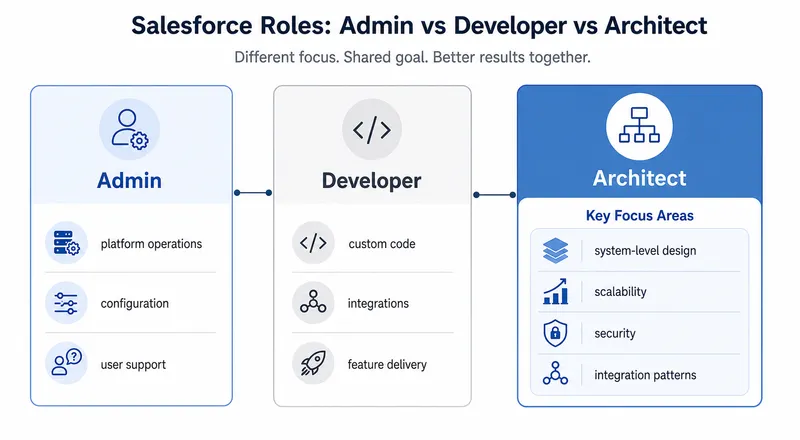
- Salesforce Admins keep the system healthy and usable.
- Salesforce Developers extend the platform with code.
- Salesforce Architects decide how the system fits together so it remains coherent, scalable, and aligned to business goals.
In modern teams, architects also shape operating models, decision governance, and delivery quality, not just target-state design. In practice, that often means resolving trade-offs before they become production issues rather than simply producing future-state diagrams.
🏗️ Key responsibilities of a Salesforce architect
Section titled “🏗️ Key responsibilities of a Salesforce architect”In practice, these responsibilities boil down to designing Salesforce solutions that are Trusted, Easy, and Adaptable, mirroring the Salesforce Well‑Architected framework’s focus on security, speed to value, and long‑term evolvability rather than one‑off project wins.
-
Solution Design & Architecture Create end-to-end Salesforce solutions that balance scalability, performance, security, and maintainability across multiple clouds and systems.
-
Technical Roadmapping Define multi-phase roadmaps, migration strategies, and technology choices for how Salesforce will evolve over time, not just in the next sprint.
-
Governance & Best Practices Establish coding standards, architecture review processes, security frameworks, and development guidelines so teams build consistently and safely.
-
Platform Strategy Evaluate Salesforce features and products against requirements, deciding when to use out-of-the-box capabilities, when to configure, and when to invest in custom development.
-
Integration Architecture Design integration patterns connecting Salesforce with ERP, marketing platforms, data warehouses, and custom systems using APIs, middleware, events, and data pipelines. For larger estates, that often means moving away from fragile point‑to‑point integrations towards clearer patterns such as API‑led connectivity (separating system, process, and experience APIs) or event‑driven designs, so new projects can reuse and compose capabilities instead of reinventing them.
In one implementation, we replaced three separate point‑to‑point ERP integrations with a shared API‑led layer and consistent contract, so future changes touched a single interface instead of three different code paths.
-
Performance & Scalability Architect for high-volume use cases, applying bulkification, asynchronous processing, caching strategies, and other patterns to keep the org responsive at scale.
-
Security Architecture Design robust security models including sharing, field-level security, encryption, identity and access management, and compliance with industry regulations.
-
Technical Leadership Mentor Admins and Developers, run design reviews, communicate trade-offs to stakeholders, and ensure solutions align with Salesforce Well-Architected principles and broader platform best practices. Strong architects use frameworks like Salesforce Well-Architected as a shared language, so design discussions stay anchored in explicit principles rather than personal preference.
⚙️ Operational responsibilities in production orgs
Section titled “⚙️ Operational responsibilities in production orgs”Depending on team structure, Salesforce architects often stay involved well beyond initial design work. In practice, many of the most important architecture decisions are made under production pressure: when a release exposes hidden coupling, when an integration starts breaching limits, or when a security model no longer fits how teams actually operate.
🔄 Ongoing governance and risk review
Section titled “🔄 Ongoing governance and risk review”- Review architecture risks and recurring defects, then steer teams towards durable fixes.
- Monitor performance patterns, integration bottlenecks, and platform limit pressure across critical domains.
- Maintain architecture standards, decision records, and reference patterns so teams can build consistently.
- Support security and compliance reviews where design choices affect shared platform risk.
🚦 High-risk release and escalation support
Section titled “🚦 High-risk release and escalation support”- Guide release governance for high-risk changes, including deployment sequencing and rollback planning.
- Review cross-team dependencies before major launches, especially where integrations, security changes, or data migrations interact.
- Step in when incidents point to a system-level design issue rather than a one-off delivery defect.
- Help delivery teams decide when a short-term workaround is acceptable and when it will create avoidable long-term risk.
A common example is a release where several teams touch the same high-volume object at once: a new Flow heavy automation, a revised sharing model, and an updated integration feed. Each change may pass isolated testing, but in production they collide: limits spike, batch jobs back up, and users see inconsistent data. In that situation, the architect’s job is not to debug a single Flow. It is to step back, map the coupling across automation, sharing, and integrations, and reshape the release plan and platform patterns so the same type of incident does not happen again.
In smaller teams, architects may directly own many of these responsibilities. In larger teams, they usually partner with platform operations, security, release, and engineering leadership. The role is rarely about owning every task personally; it is about owning the quality of the system-level decisions behind those tasks.
🤝 Architect, admin, and developer boundaries
Section titled “🤝 Architect, admin, and developer boundaries”Strong Salesforce teams treat these roles as complementary, not competing:
- Admins usually lead declarative configuration, user operations, and platform support.
- Developers usually lead custom implementation, integrations, and code-level delivery.
- Architects usually lead system-level design, governance, and long-term technical direction.
For a closer look at the related roles, see Understanding the Role of a Salesforce Administrator and Exploring the Role of a Salesforce Developer.
Where teams get into trouble is not usually the overlap itself, it is unclear decision ownership. Good teams decide ownership based on business impact, technical risk, and maintainability.
Three common examples make that boundary clearer:
- Flow versus Apex: Admins and Developers may both contribute to the implementation, but Architects should step in when automation choices affect limits, reuse, supportability, or platform-wide standards.
- Integration pattern choice: Developers can build a working integration, but Architects decide when an org needs a broader pattern such as events, middleware, API-led reuse, or a stronger contract model.
- Security and release risk: Admins may own access changes and Developers may own code changes, but Architects review decisions when those changes affect shared trust boundaries, deployment sequencing, or compliance exposure.
These boundaries are guidelines, not rigid job-title fences, which is exactly why effective teams stay explicit about who owns the final system-level trade-off.
🧠 Key skills for a Salesforce architect
Section titled “🧠 Key skills for a Salesforce architect”In my experience, the difference between a strong solution lead and a strong architect is not just broader platform knowledge, it is the judgment to apply the right pattern, at the right time, for the right level of organisational risk.
- Strategic Thinking – Turning business strategy into practical, phased Salesforce solutions
- Deep Platform Knowledge – Understanding limits, patterns, and architecture across multiple clouds
- Design Patterns – Applying integration, security, data, and scalability patterns in real implementations
- Leadership & Communication – Influencing stakeholders, explaining complex topics simply, and providing clear technical direction
- Trade-off Analysis – Balancing speed, cost, risk, and maintainability when making design decisions
- Enterprise Experience – Designing for complex, multi-cloud, high-volume environments, often with multiple regions or business units
🏢 When a team needs architecture capacity
Section titled “🏢 When a team needs architecture capacity”Not every organisation needs a full-time Architect, but every team needs a clear way to make high-impact design decisions:
| Situation | Sensible architecture coverage |
|---|---|
| A small, single-cloud org with limited integration and low change volume | An experienced Admin or Developer can lead design, with specialist review for security or integration risk |
| Several delivery teams are changing shared objects, automation, or integrations | Assign an Architect to set patterns, review cross-team impact, and keep decision records |
| A transformation, org consolidation, major migration, or multi-cloud programme is under way | Use dedicated architecture leadership from discovery through transition and operational handover |
| The platform carries regulated data or critical business processes | Make security, continuity, auditability, and recovery explicit architecture accountabilities |
| Design conflicts, release incidents, and duplicated integrations keep recurring | Add architecture capacity and governance before increasing feature throughput |
Architecture capacity can be a full-time role, a fractional responsibility, or a formal review group. What matters is that consequential decisions have a named owner, evidence, and a review point.
🚩 Signs a team needs more architecture capacity
Section titled “🚩 Signs a team needs more architecture capacity”A practical way to identify this need is to look for repeated system level problems rather than one-off delivery issues.
Here are common signs:
- Teams keep making conflicting design choices across projects.
- Integration complexity increases and no shared pattern is being followed.
- Security and compliance reviews repeatedly uncover avoidable design risks.
- Releases become fragile because foundational architecture decisions were deferred.
- Technical debt accumulates faster than teams can safely pay it down.
Increasing architecture capacity can mean dedicating more time to architectural work, clarifying decision ownership, or formalising review processes, not just hiring.
📈 Career path and opportunities
Section titled “📈 Career path and opportunities”A useful starting point is Salesforce’s Architect: Quick Look module, followed by the structured Architect career path that maps the certifications leading towards Salesforce Certified Technical Architect (CTA).
In practice, most architects do not start with the architect title. They usually grow into the role from strong Admin, Developer, consultant, or solution lead experience, then deepen their capability across security, integrations, data, and governance.
My first architect role was not especially tidy. I learned a few things quickly and made a few mistakes just as quickly. Looking back, the biggest change was not getting the title, it was shifting my mindset.
The role only started to make sense when I stopped thinking only about how to deliver the next solution and started thinking about trade-offs, long-term platform consequences, governance, and how decisions would hold up across the wider system. That was the point where I felt I was genuinely doing the role rather than just occupying it.
Key milestones include:
- Application Architect – Focused on data, sharing, and application design
- System Architect – Focused on integrations, identity, and system-level concerns
- Salesforce Certified Technical Architect (CTA) – The highest level of technical achievement, demonstrating the ability to design and defend complex enterprise architectures
Along the way, domain certifications such as Data Architect, Integration Architect, and Identity & Access Management Designer deepen expertise in specific areas.
The Salesforce Architect site is also worth bookmarking for reference architectures, patterns, and practical thought leadership.
✅ Conclusion
Section titled “✅ Conclusion”Salesforce Architects create value when a platform stops being just a set of features and starts behaving like a shared system with real design consequences. The role matters most when organisations need someone to make durable decisions about integration boundaries, security posture, release risk, scalability, and long-term maintainability rather than solving each project in isolation.
For organisations treating Salesforce as a core business platform, that guidance prevents expensive rework, reduces delivery friction, and helps teams scale without losing coherence. If you are deciding whether you need more architecture capacity, look for repeated design conflicts, fragile releases, or solutions that work locally but weaken the platform as a whole.
If you want to compare where architecture ends and adjacent role ownership begins, continue with Understanding the Role of a Salesforce Administrator and Exploring the Role of a Salesforce Developer.
Use the official resources below for certification detail, formal learning paths, and reference architectures. The goal of this guide is to help you recognise how the role operates in real teams and why architectural judgment becomes more valuable as platform complexity grows.