Exploring the Role of a Salesforce Developer

Salesforce Developers become most visible when business requirements outgrow point-and-click configuration. They write the code that powers custom features, connects external systems, and keeps solutions workable when complexity, scale, and integration demands exceed what declarative tools can handle cleanly.
This guide breaks down what a Salesforce Developer actually does day-to-day, how the role collaborates with Admins and Architects, and where developers deliver the most impact in production projects. For the broader role context, see Which hat are you wearing: admin, dev, or architect?.
I’ve always enjoyed creating things with code. That developer mindset still shapes how I approach problem-solving, debugging, and mentoring, even as my career has expanded into architecture and platform governance.
🧑💻 What is a Salesforce developer?
Section titled “🧑💻 What is a Salesforce developer?”A Salesforce Developer specialises in extending the platform through code. They use Apex, Lightning Web Components, integration patterns, and platform services to build custom applications, automate complex processes, and solve problems that point-and-click configuration cannot handle safely or efficiently.
In modern teams, developers own more than just feature delivery. They also drive release quality, observability, technical debt management, and platform governance.
🗂️ Key responsibilities of a Salesforce developer
Section titled “🗂️ Key responsibilities of a Salesforce developer”From day-to-day development to production support, Salesforce Developers handle a broad range of responsibilities:
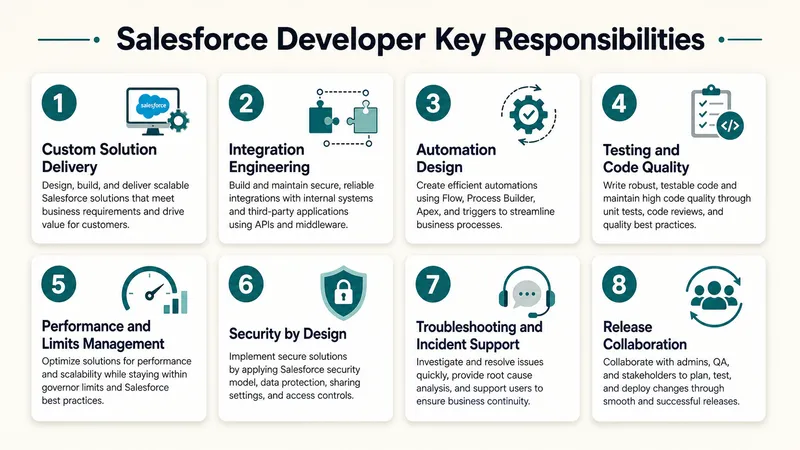
- Custom Solution Delivery: Build features using Apex, Lightning Web Components, and platform services when declarative tools are not sufficient.
- Integration Engineering: Design and maintain reliable integrations using APIs, platform events, and middleware patterns.
- Automation Design: Implement scalable automation with the right mix of Flow and Apex, especially for complex or high-volume scenarios.
- Testing and Code Quality: Create meaningful unit tests, support integration testing, and maintain code quality standards for safe deployments.
- Performance and Limits Management: Design for governor limits, bulk processing, query selectivity, and predictable runtime behaviour.
- Security by Design: Apply secure coding practices and enforce object, field, and record-level access requirements in code paths.
- Troubleshooting and Incident Support: Diagnose production defects, reduce recurrence, and improve observability for faster recovery.
- Release Collaboration: Work with release, QA, and admin teams to deploy safely and maintain stable delivery pipelines.
These responsibilities vary by team size and structure. In smaller teams, developers might own most of them directly, while larger organisations distribute them across specialised engineering, integration, quality, and release roles.
⚙️ Operational responsibilities in production orgs
Section titled “⚙️ Operational responsibilities in production orgs”Depending on team structure, Salesforce Developers often support platform operations beyond feature development. In practice, some of the most valuable developer work happens after release: tracing recurring failures, reducing technical debt, and improving how reliably the platform behaves under real production load.
🔄 Typical ongoing responsibilities
Section titled “🔄 Typical ongoing responsibilities”- Monitor exception trends and recurring failures, and focus on fixing the root cause, not just the symptom.
- Track integration reliability including retries and API usage to catch issues before they become incidents
- Strengthen fragile automations and gradually reduce the technical debt slowing the team down
- Support release cutovers, hotfixes, and post-release checks to keep deployments stable
- Collaborate with Admins on permission model changes, which can affect how your code behaves
Depending on your team size, the developer might own most of these responsibilities directly, or they might partner with platform operations, DevOps, and architecture teams to deliver them.
🤝 Developer and admin boundaries
Section titled “🤝 Developer and admin boundaries”The strongest Salesforce teams don’t treat Admin and Developer work as competing domains.
- Admins usually lead configuration, user enablement, and operational process ownership
- Developers usually lead custom code, complex integrations, and advanced technical design
- Architects usually lead system-level design, governance, and long-term technical direction
Most delivery work sits between these roles. Effective teams decide ownership based on complexity, risk, and maintainability rather than title.
🧠 Key skills for a Salesforce developer
Section titled “🧠 Key skills for a Salesforce developer”- Apex and Lightning development: Strong implementation in Apex and Lightning Web Components.
- Platform architecture awareness: Working knowledge of data model design, sharing and security models, and platform constraints.
- SOQL and performance tuning: Ability to write selective queries and design for bulk-safe execution.
- Integration design: Practical understanding of REST, events, authentication patterns, and error handling
- Testing mindset: Commitment to quality through reliable test coverage, meaningful assertions, and release discipline.
- Collaboration and communication: Ability to work effectively with Admins, Architects, QA, product owners, and business stakeholders.
🏢 When a team needs Developer capacity
Section titled “🏢 When a team needs Developer capacity”Salesforce’s declarative tools handle a lot, so “the requirement is complicated” is not enough reason to write code. Use the boundary below to identify the capability you actually need:
| Requirement or signal | Best first response |
|---|---|
| A standard process with clear rules, screens, and moderate record volume | Start with configuration or Flow, owned by an Admin or declarative builder |
| Complex data processing, transaction control, reusable logic, or high automation density | Bring in a Developer to assess Apex or a Flow-and-Apex pattern |
| A custom user experience that standard Lightning components cannot deliver cleanly | Use a Developer for Lightning Web Components, with user research and accessibility requirements defined first |
| An API, event-driven integration, or non-trivial authentication and error-handling requirement | Use Developer capacity within an agreed integration architecture |
| Repeated code defects, slow reviews, risky releases, or an integration backlog | Add engineering capacity and fix delivery practices, not just feature throughput |
The decision should leave an audit trail. Record why declarative options were insufficient, who will own the code, how failures will be monitored, and how the change will be tested and deployed. Code is valuable when it gives the team control it genuinely needs; otherwise it creates another asset that must be supported.
🚩 Signs a team needs more developer capacity
Section titled “🚩 Signs a team needs more developer capacity”A simple way to think about this is: when your team faces technical challenges that Salesforce’s point-and-click tools (like Flow or standard configuration) can’t handle, you likely need more developer support.
Here are common signs:
- Work gets stuck: Integration or coding tasks sit in the queue too long, blocking important delivery
- Performance problems recur: The same performance issues keep coming back in high-volume areas
- Releases feel risky: Deployments depend on urgent hotfixes instead of following a stable process
- Security needs code-level controls: Compliance requirements demand stronger safeguards than configuration provides
- Admin request backlog grows: Admins have more requests for Apex, API integrations, or custom UIs than standard tools can handle
More developer capacity doesn’t always mean hiring immediately. It can also mean dedicating more developer time, improving team planning, or clarifying how Admin, Developer, and Architect responsibilities are shared.
📈 Career path and opportunities
Section titled “📈 Career path and opportunities”If you’re interested in becoming a Salesforce Developer, Salesforce offers a structured Developer Career Path on Trailhead that guides the skills and certifications needed to advance in this field. Relevant credentials include Salesforce Certified Platform Developer and Salesforce Certified Platform Developer II, which cover progressively deeper skills in building custom applications on the platform.
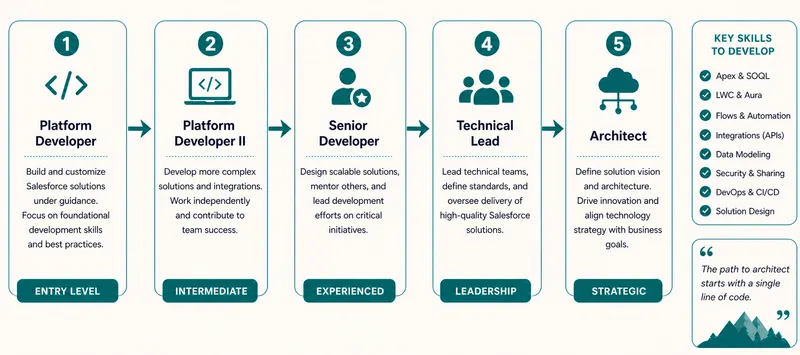
Common milestones often look like this:
- Platform Developer – Establish core Apex, Lightning, testing, and platform skills.
- Mid-level or Senior Developer – Take ownership of integration design, performance issues, release quality, and more complex delivery decisions.
- Technical Lead or Architect-track Developer – Move beyond implementation alone and start shaping standards, patterns, and broader system design decisions.
The Salesforce Developer site is also a valuable resource for documentation, tooling, events, and community support. You can also explore the Explore Core Salesforce Developer Responsibilities trail to see how developers build trusted solutions on the platform.
The official career path is useful as a learning map, but production capability also comes from code review, debugging, release support, and learning to explain technical trade-offs to non-developers.
✅ Conclusion
Section titled “✅ Conclusion”A Salesforce Developer creates value when the platform needs more than configuration alone can safely provide. The role matters most when organisations need durable custom logic, integration reliability, performance discipline, and code-level ownership that supports the wider platform rather than adding fragile complexity.
For organisations that rely on Salesforce for serious delivery, strong developer capability improves solution quality, reduces technical risk, and expands what the platform can do without sacrificing maintainability.
If, like me, you enjoy creating things with code and working through difficult technical problems, the role can be deeply satisfying. The important distinction is that production development is not just feature building: it includes testing, observability, release discipline, documentation, and supporting what you ship.
If you want to compare where developer ownership ends and adjacent roles begin, continue with Understanding the Role of a Salesforce Administrator and Understanding the Role of a Salesforce Architect.
Use the official resources below for formal learning paths, role guidance, and hands-on practice.