Salesforce Marketing Cloud Engagement: Journeys & Email

What happens after someone clicks your ad, explores your site, and then disappears? That is the moment journey design matters most, and where marketers either lose a lead or build a lasting relationship.
Marketing Cloud Engagement helps teams orchestrate messaging across email, SMS, push notifications, and advertising audiences. It is one product in a wider—and increasingly easy to confuse—marketing portfolio. Salesforce calls the platform-native product Marketing Cloud Next (also known as Agentforce Marketing), with Growth Edition and Advanced Edition among its editions. Marketing Cloud Next and Marketing Cloud Engagement are distinct products, so confirm which one a requirement, licence, or piece of documentation refers to.
In this guide, you will get a practical, plain-English overview of Marketing Cloud Engagement and learn how to apply its core capabilities for segmentation, automation, measurement, and governance in everyday marketing work.
🧭 Which Marketing Product Are You Choosing?
Section titled “🧭 Which Marketing Product Are You Choosing?”| Primary need | Product to evaluate | Watch before committing |
|---|---|---|
| High-volume B2C journey orchestration using Email Studio and Journey Builder | Marketing Cloud Engagement | Separate platform concepts, business units, contact model and specialist skills; do not assume core-platform administration transfers directly. |
| Marketing built natively around Data 360 and the Salesforce Platform | Marketing Cloud Next — Growth Edition or Advanced Edition | Edition, Data 360 consumption, channel coverage and regional availability must match the roadmap. |
| B2B lead nurture and sales alignment | Marketing Cloud Account Engagement | Fit depends on the B2B lead and campaign process; it is not a replacement for every Engagement use case. |
| Customer-profile unification and audience activation | Data 360 plus an activation destination | Data 360 creates and activates profiles; it does not by itself replace the messaging product that sends the campaign. |
This guide focuses on Marketing Cloud Engagement. Product names may sit beside each other on a proposal, but their data models, setup, implementation skills and commercial entitlements are not interchangeable.
🌐 What is Salesforce Marketing Cloud Engagement?
Section titled “🌐 What is Salesforce Marketing Cloud Engagement?”Salesforce Marketing Cloud Engagement is a digital marketing platform that allows businesses to create, manage, and optimise customer journeys across multiple channels. It offers tools for email marketing, content management, advertising, and more, enabling marketers to deliver personalised experiences at scale. Marketing Cloud Engagement supports customer engagement at every stage, from initial awareness to ongoing advocacy.
🧰 The Operating Surfaces That Matter
Section titled “🧰 The Operating Surfaces That Matter”| Surface | What it controls | Common failure mode |
|---|---|---|
| Email Studio | Audience sends, email configuration and tracking | Poor list hygiene or sender configuration damages deliverability. |
| Journey Builder | Event-driven, scheduled and API-triggered journey orchestration | Contacts re-enter unexpectedly or remain in journeys after the business rule changes. |
| Content Builder | Reusable content and personalisation assets | Shared content changes affect more sends than the editor expected. |
| Mobile channels | SMS and push engagement where licensed and configured | Consent, quiet hours and regional channel rules are applied inconsistently. |
| Analytics and data integrations | Performance measurement, segmentation inputs and activation | Teams optimise clicks while losing sight of the business outcome or data lineage. |
| Data 360 integration | Unified profiles, calculated insights, segments and activation | Identity resolution and consumption assumptions are left until after journey design. |
The value comes from coordinating these surfaces around a measurable customer outcome. It does not come automatically from adding more branches to a journey. Start with one audience, one entry rule, one exclusion model and one outcome; expand only after the team can explain who entered, why they received each message, and how they leave.
🔗 How Marketing Cloud Engagement Complements Other Salesforce Clouds
Section titled “🔗 How Marketing Cloud Engagement Complements Other Salesforce Clouds”Marketing journeys are only as smart as the data feeding them, and most of that data lives in the other clouds.
- Sales Cloud: Use lead and opportunity data to trigger nurture journeys, improve handoffs, and align campaign timing with pipeline stages.
- Service Cloud: Combine case and support context with engagement history to improve retention messaging and proactive service communications.
- Commerce Cloud: Activate shopping and transactional behaviour in campaigns for cart recovery, post-purchase journeys, and loyalty programs.
👥 Roles That Commonly Use Marketing Cloud Engagement
Section titled “👥 Roles That Commonly Use Marketing Cloud Engagement”Marketing Cloud Engagement is often a cross-functional platform. Which roles are involved can vary based on team structure, org maturity, and implementation scope.
- Marketing Specialists and Campaign Managers design journeys, create content, define audience segments, and optimise campaign performance.
- Salesforce Admins may help manage data quality, permissions, configuration, and operational reliability especially when connected to the core platform.
- Salesforce Developers may build API integrations, custom automations, and event-driven extensions.
- Salesforce Architects may define integration patterns, data governance, and scalability standards across clouds.
🧭 Best Practices for Using Salesforce Marketing Cloud Engagement
Section titled “🧭 Best Practices for Using Salesforce Marketing Cloud Engagement”- Define Outcome-Based Objectives: Tie each campaign or journey to a measurable business outcome such as qualified pipeline growth, repeat purchase rate, retention, or support deflection.
- Track Core KPIs with a Fixed Cadence: Review deliverability rate, hard and soft bounce rates, unsubscribe rate, click-through rate, conversion rate, and journey completion weekly so issues are detected early.
- Use Segmentation with Eligibility Rules: Build audiences from a governed customer profile and apply explicit inclusion and exclusion rules so ineligible or unsubscribed contacts are not targeted by mistake.
- Set Governance Ownership: Assign clear ownership for data quality, campaign approvals, and journey operations across marketing, admin, and technical teams to avoid gaps in accountability.
- Apply Change Control to Journeys: Treat journey edits like controlled releases by documenting changes, testing in lower-risk environments where possible, and validating entry and exit criteria before publishing.
- Run Monthly Optimisation Reviews: Perform monthly audits for segment performance, content relevance, and automation logic, then prioritise improvements based on KPI impact and compliance risk.
🔒 Compliance, Privacy, and Operational Risk
Section titled “🔒 Compliance, Privacy, and Operational Risk”Marketing Cloud Engagement can process large volumes of personal data across email, SMS, and advertising workflows. In practice, trust and performance both depend on strong privacy controls and disciplined operational governance.
Use this governance flow as a practical checkpoint model before you activate high-volume journeys.
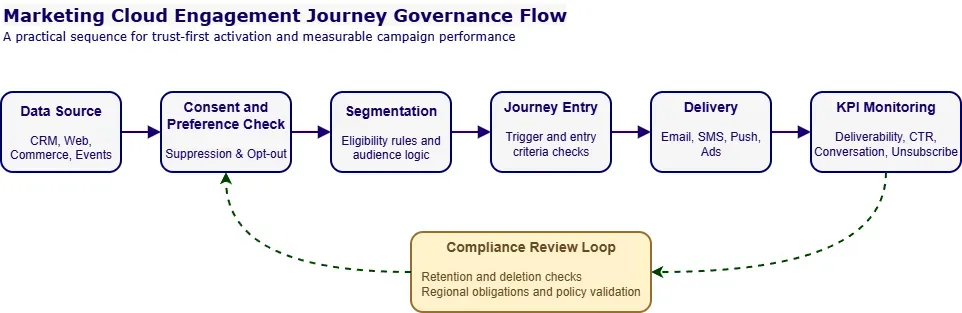
The strongest programs treat this as a recurring loop, not a one-time setup task.
- Maintain Consent and Preference Records: Keep clear records of how and when consent was captured, and ensure contact preferences are synchronised across channels before activation.
- Enforce Unsubscribe and Suppression Controls: Honour unsubscribe requests promptly and maintain suppression logic so opted-out contacts are excluded from all relevant sends.
- Define Retention and Deletion Routines: Set data retention windows and deletion workflows that align with legal, contractual, and internal governance requirements.
- Map Regional Obligations Early: Design journeys with jurisdiction-specific requirements in mind, including CAN-SPAM, GDPR, and CCPA obligations where they apply.
- Review with Legal and Compliance Stakeholders: Marketing and technical teams should partner with legal and compliance owners to validate policy interpretation before launch.
Weak governance controls create direct operational risk. Common outcomes include deliverability degradation, brand trust damage from poor consent handling, and elevated enforcement exposure when retention and preference controls are inconsistent.
🚀 Getting Started with Salesforce Marketing Cloud Engagement
Section titled “🚀 Getting Started with Salesforce Marketing Cloud Engagement”Marketing Cloud is harder to self-teach than the core clouds because free hands-on orgs are scarce (more on that below), so structured Trailhead modules carry more of the learning load here. Begin with Get to Know Marketing Cloud Engagement, the maintained Create and Send Targeted Emails trail, and Quick Start: Create and Send an Email with Marketing Cloud Engagement to get an overview of core capabilities.
Next, look for modules that provide deeper insights into how Marketing Cloud can be used to create personalised and effective marketing campaigns, such as Journey Builder Basics.
For official platform updates, architecture guidance, and developer tooling, visit the Salesforce Marketing Cloud Developer Center.
Currently, Salesforce does not offer a universally available free Marketing Cloud Developer Edition org for self-service learning. Unlike Salesforce Platform Developer Edition, Marketing Cloud usually requires paid access or access through an employer, implementation partner, or training provider.
While direct, always-on developer org access for Marketing Cloud Engagement is not universally available, you can still build hands-on experience through practical alternatives:
- Partner or Event Access: You may be able to obtain temporary personal developer access through Salesforce partner programs, workshops, or special events.
- Trailhead Virtual Labs (When Available): Trailhead occasionally offers lab-style environments for guided hands-on practice, though availability can vary by region, event, and program.
🏁 Conclusion
Section titled “🏁 Conclusion”Teams that get consistent results treat Marketing Cloud Engagement as both a messaging platform and a way of working. The tools can personalise journeys at scale, but performance comes from disciplined segmentation, clear KPIs, and governance that protects customer trust.
If you are starting out, keep it simple: launch one focused journey, review results weekly, and improve in small iterations. As your program matures, align work across marketing, data, and compliance teams, strengthen consent and data-use controls, and use Salesforce’s official documentation and architecture guidance to validate key decisions.
That mix of practical execution, measurable outcomes, and responsible governance is what turns campaigns into reliable, long-term customer engagement.